From Gaza – Omnia Abu Al-Khair Masoud
“We have nothing left to eat. During the winter, we survived on wild plants that grew from the soil, such as mallow and nettles. Now, even those have become scarce. When we manage to find something, the prices are beyond our reach. We have resorted to eating mulberry leaves just to silence our hunger. But where are we supposed to get the money to buy food when our livelihoods have been wiped out since the war began on October 7?”
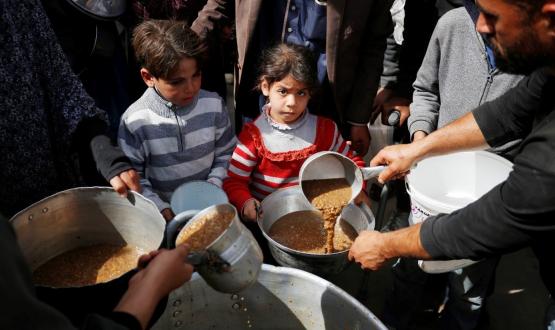
For residents of northern Gaza, hunger is no longer a distant threat. It has returned with renewed force, deepening an already devastating humanitarian crisis and leaving families struggling to secure even the most basic food supplies
After months of famine-like conditions during the first six months of the war, the specter of hunger has once again tightened its grip on the population, particularly in northern Gaza. The closure of the Rafah crossing and severe restrictions on the entry of commercial goods and humanitarian supplies through other crossings have further undermined people's ability to access food
Nabila Al-Qattaa describes the food situation as catastrophic. Vegetables and meat have virtually disappeared from local markets, including frozen products. Fruit has become an almost unimaginable luxury, while basic staples such as legumes, sugar and salt are either unavailable or sold at prices far beyond what ordinary families can afford
Nabila, 58, who lives in the Al-Tuffah neighborhood of Gaza City, says the crisis is compounded by the complete loss of income and the absence of cash
“There is no work and no money. Purchasing power in the north has practically disappeared. Some goods entered the markets for only about ten days, but we could not afford them because prices were so high. We had hoped more supplies would arrive and prices would fall. Instead, the goods disappeared, and we found ourselves facing hunger all over again,” she says
A mother of six, Nabila explains that her family has been forced to rely on whatever edible plants they can find. During the winter, they collected wild mallow, nettles and other seasonal greens. In the summer, they have turned to mulberry leaves as a substitute for grape leaves, although even these are becoming increasingly difficult to find
Her family cooks tomato paste over an open wood fire and eats it with bread as a substitute for fresh tomatoes. At other times, they prepare simple pastries using za'atar, traditional Palestinian seasoning and canned meat
The consequences extend far beyond an empty stomach. Nabila says children are hungry most of the time, while adults suffer from weakness, exhaustion and an inability to carry out their daily activities
People who become ill also struggle to recover because nutritious food, healthy meals and medicines are increasingly unavailable
“This is a form of daily torture. We have already endured bombardment, displacement and the loss of loved ones. Now we are being punished through our stomachs. All we want is for food supplies, vegetables and poultry to be allowed into Gaza,” she says
The Threat of Famine Is Growing
The Government Media Office in Gaza has repeatedly warned that the threat of famine is growing, raising fears of a further increase in deaths, particularly among vulnerable groups
According to figures released by the office at the time, 34 people had died as a result of famine-related conditions. It also warned that approximately 3,500 children were at risk of death due to malnutrition and the lack of food, nutritional supplements and vaccinations
A report by the Integrated Food Security Phase Classification (IPC) indicated that more than half of Gaza's population had no food stocks, while more than 20 percent of residents were going entire days without eating
Journalist Momen Meqdad, who lives in western Gaza City, is a father of four and shares a home with around 40 people. He describes the situation in northern Gaza as extremely difficult, with markets lacking vegetables, fruit and meat
His family depends largely on assistance provided by humanitarian organizations, but even some of these supplies must be purchased at inflated prices
“Most of our meals now consist of bread, za'atar and traditional seasoning. There are no vegetables, fruits or meat. This kind of diet is leaving many people suffering from constipation, physical weakness and exhaustion,” he says
Meqdad says the absence of cooking gas has created another daily struggle. Families spend hours collecting firewood simply to prepare their meals, adding yet another burden to lives already shaped by displacement and deprivation
Unsafe Food and Worsening Malnutrition
The growing food crisis has also forced families to rely on canned goods, sometimes without knowing whether the products are safe to consume.
The Ministry of Health previously reported that more than 60 displaced people at a shelter in Beit Lahia, northern Gaza, had suffered food poisoning after consuming expired and spoiled food.
The Emergency Committee attributed the deterioration of food supplies to aid trucks being left for extended periods under the sun while waiting to enter Gaza, causing some canned products to spoil.
For Fatima Al-Da'ama, 37, from Jabalia town in northern Gaza, this has made checking every can before opening it an essential part of daily survival.
Fatima lives with her extended family of 25 people. She says they have been suffering from poor nutrition for nine months, largely because their diet has become heavily dependent on canned products containing preservatives, while fresh vegetables, fruit and meat remain largely unavailable.
“The fatigue and lethargy have become part of our everyday lives. We also suffer from bone pain. I feel all these aches even though I am still young. What must older people, children and pregnant women be going through?” she asks.
According to reports issued by UNICEF, one in three children in northern Gaza was suffering from acute malnutrition or wasting.
Fatima says her family often has to eat bread without anything to accompany it. When available, they use canned food sparingly and supplement their meals with wild purslane and mulberry leaves.
Even finding these plants has become difficult and sometimes dangerous, she explains.
“We have to make whatever little food we can find last as long as possible,” she says
Markets Empty, Basic Necessities Out of Reach
Mohammed Abu Warda, head of the North Gaza Chamber of Commerce and Industry, says the range of goods entering northern Gaza has been severely restricted
“Only canned food and flour are entering northern Gaza, mainly through some international organizations, and in quantities that are nowhere near sufficient for the population,” he says
He explains that commercial goods are not entering the area in meaningful quantities, whether through Gaza's border crossings or through traders transporting supplies from the southern part of the Strip.
Markets have been stripped of vegetables, fruit, meat, children's food and other essential necessities. Whatever remains available is sold at exorbitant prices.
The scale of humanitarian needs has also raised alarm among United Nations agencies.
Inas Hamdan, UNRWA's Director of Communications in Gaza at the time, warned that the needs were enormous and could not be adequately described.
Without regular and sufficient deliveries of humanitarian supplies, she cautioned, Gaza could face a severe hunger crisis by mid-July.
Hamdan described the delivery of aid as extremely complicated, pointing to numerous restrictions and the limited functioning of land crossings and access routes.
Regarding northern Gaza, she explained that UNRWA was not permitted to operate effectively in the area. The World Food Programme was overseeing the entry of assistance, while, in coordination with UNRWA, flour was being distributed through designated distribution centers.
She also warned that dwindling supplies, combined with the breakdown of law and order in Gaza, could further undermine humanitarian operations and prevent assistance from reaching those who needed it most.
Humanitarian Organizations Warn of a Wider Famine
Raed Al-Nims, Director of Media at the Palestine Red Crescent Society (PRCS), warned that the humanitarian situation across the Gaza Strip was deteriorating and that famine could spread to all governorates, rather than remaining confined to the north.
He attributed the worsening crisis to restrictions on humanitarian aid following the closure of the Rafah crossing, which came under Israeli control, as well as repeated attacks on humanitarian workers and relief operations.
“If the military assault continues in the same way, the humanitarian crisis will deepen, and we fear a new famine that could affect every part of the Gaza Strip,” Al-Nims said.
He noted that the Palestine Red Crescent Society had informed the International Committee of the Red Cross (ICRC) and the World Health Organization (WHO) about the severe shortages of food, medicine and drinking water affecting residents in northern Gaza, urging the organizations to take immediate action.
Al-Nims explained that the Red Crescent had previously received humanitarian assistance and supervised its distribution among displaced people in shelters and hospitals. However, the situation had changed dramatically, with aid deliveries no longer reaching the population as needed.
The organization had also attempted to break the restrictions by preparing trucks loaded with various essential supplies and dispatching them toward Gaza City and northern Gaza. However, Israeli forces prevented the trucks from entering.
According to monitoring by the Government Media Office, only nine aid trucks entered Gaza over ten consecutive days, most carrying flour and canned food.
On May 7, 2024, Israeli forces took control of the Rafah crossing, effectively halting the entry of humanitarian assistance through the vital border point. This came a day after Israel announced the beginning of its military operation in Rafah, despite repeated international warnings about the catastrophic humanitarian consequences of such an escalation.
For families across northern Gaza, the consequences are measured in meals missed, children going hungry, parents struggling to find something to cook and patients unable to recover because their bodies lack the nutrition they need.
What was once a struggle to survive bombardment and displacement has become an increasingly desperate battle against hunger itself. And as food supplies continue to dwindle, the fear is no longer simply that families will have less to eat, but that many may soon have nothing at all
.